

Scroll Top
  • Home
  • News
  • Qualification Centre Marks One Year: An Interview with Viktoriia Sydorenko on Key Results and Future Plans
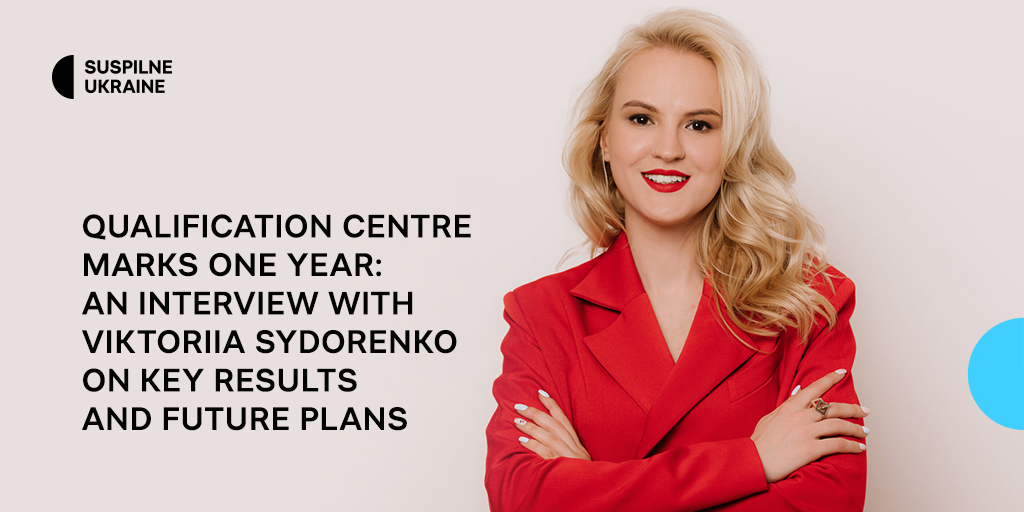
Qualification Centre Marks One Year: An Interview with Viktoriia Sydorenko on Key Results and Future Plans

Qualification Centre Marks One Year: An Interview with Viktoriia Sydorenko on Key Results and Future Plans

Поділитись

September 16 marked one year since Ukraine’s first Qualification Centre* began operating at Suspilne Ukraine. The Centre awards the professional qualification of “Journalist.” Viktoriia Sydorenko, Director of Human Resources at Suspilne Ukraine and initiator and project lead behind the Centre, spoke about its key achievements over the past year and the team’s plans for the year ahead.

Viktoriia, the Qualification Centre has been operating for a year. What key results have you achieved by this milestone?

— We built the Qualification Centre “from scratch,” and I think that is the right way to put it, because when we started, there was no comparable example on the Ukrainian market. We developed an assessment methodology, engaged experts to create a bank of assessment tasks, and, as assessors, went through a review of all procedures and the accreditation process with the National Qualifications Agency.

But most importantly, over this period, 53 people have completed the assessment, 13 of whom have already received certificates confirming the award of the professional qualification. This means we have confirmation that the Centre is up and running and becoming sought after: people take the assessment, receive a document recognized by the state and employers, or, if they do not pass the exam, prepare and apply again. This proves that such a format for recognizing non-formal and informal learning is viable, that the procedure is not merely a formality, and that the exam sets demanding standards for the quality of knowledge.

— How would you describe the typical candidate based on the experience of the past year? Are they mostly newcomers to the profession or experienced specialists? What motivates them to take the assessment, and what do they find most difficult — or easiest — about the exam?

— Many candidates have experience in journalism but no formal education in the field. They make up the majority. Obviously, they are motivated by the opportunity to obtain a certificate and formal confirmation of their professional qualification without having to pursue a master’s degree. But there are also people who decided to change their career path and entered the profession only recently. We also had graduates this year with specialized education who decided to test their knowledge.

I cannot say that there is one specific area of knowledge that is difficult for absolutely everyone. I often hear from candidates that the English-language tasks are challenging, although there are not many of them and it is possible to achieve a passing score without them. The basics of law, spelling, and the practical application of journalistic standards can also be challenging.

The assessment is easier when it covers something you work with more frequently, so everything depends on a person’s individual knowledge and experience. When preparing, I always recommend spending more time on the topics in which a person has the least practical experience.

— Which results have surprised the Centre’s team most or exceeded your expectations?

— The candidates’ persistence and the seriousness of their preparation have been a pleasant surprise. People really do prepare: they reread the professional standard, refresh their knowledge of legislation, and analyze their own professional practice. This is very noticeable during the assessment. Some people come for the first time without preparation simply to understand the procedure, see what the exam is like in practice, and assess their starting level of readiness. They then prepare more thoroughly and successfully pass the assessment the second time. In other words, simply taking the assessment and preparing for it already helps improve a person’s level of knowledge.

— Does the Centre plan to expand the list of professions in the near future? If so, in which fields?

— Yes, and this is one of our priorities. In the near future, we plan to develop professional standards in media production and introduce another qualification within the Centre. This is a logical next step, because media production is another field with many practitioners who have real-world experience but no formal confirmation of their qualifications. And, just as with journalism, Suspilne Ukraine is interested in these professionals.

What are the key priorities for the Qualification Centre’s second year of operation?

— First, it is the development of new professional standards.

We are currently working with the Perfect PR agency and the All-Ukrainian Advertising Coalition (VRK) to develop a draft professional standard for public relations managers. We have a practical interest in this as well: to clearly distinguish PR from journalism at the level of national standards. Next, as I mentioned, we will begin work on a standard for one of the professions in media production.

Second, we plan to launch another professional qualification at the Centre and obtain the corresponding additional accreditation.

And, of course, we want to engage more candidates, both from among Suspilne employees and from outside the broadcaster. The Centre was created not only to meet the company’s internal needs but also as an instrument for the entire market.

— As you mentioned, you created this project essentially “from scratch.” What does the Qualification Centre mean to you personally, and why is it important?

— For me, it is about the institutional dimension of Suspilne’s work and about how a media organization can take responsibility for developing standards across the entire industry, rather than only within its own organization. In other words, it is about professionalizing Ukraine’s media community. It is also about trust in experience — recognizing that years of high-quality practical work constitute real professional qualifications that deserve recognition.


*The Suspilne Qualification Centre is authorized by the National Qualifications Agency to assess candidates and award the professional qualification of “Journalist.” This means recognizing knowledge and skills acquired through both formal learning and practical work through non-formal and informal learning, as well as confirming qualifications obtained abroad. It is the first and, so far, the only centre of its kind in Ukraine. After successfully completing the assessment, participants receive an official certificate recognized by employers and the state and entered into the relevant register.

Suspilne Ukraine is an independent media company with a strong presence across all platforms: the TV channels Pershyi, Suspilne Kultura, Suspilne Sport, and a national network of local channels; the radio stations Ukrainske Radio, Radio Promin, Radio Kultura, Radiotochka. Find only verified news on suspilne.media, as well as on our national and local digital platforms. We broadcast in minority languages, represent Ukraine at the Eurovision Song Contest, develop the children’s platform Brobaks, and train media professionals through the Public Media Academy. Our Suspilne Mediateka platform offers unique video and audio archives dating from the 1920s to today. Defending freedom in Ukraine. 
Поділитись
Qualification Centre Marks One Year: An Interview with Viktoriia Sydorenko on Key Results and Future Plans

Qualification Centre Marks One Year: An Interview with Viktoriia Sydorenko on Key Results and Future Plans

Поділитись

September 16 marked one year since Ukraine’s first Qualification Centre* began operating at Suspilne Ukraine. The Centre awards the professional qualification of “Journalist.” Viktoriia Sydorenko, Director of Human Resources at Suspilne Ukraine and initiator and project lead behind the Centre, spoke about its key achievements over the past year and the team’s plans for the year ahead.

Viktoriia, the Qualification Centre has been operating for a year. What key results have you achieved by this milestone?

— We built the Qualification Centre “from scratch,” and I think that is the right way to put it, because when we started, there was no comparable example on the Ukrainian market. We developed an assessment methodology, engaged experts to create a bank of assessment tasks, and, as assessors, went through a review of all procedures and the accreditation process with the National Qualifications Agency.

But most importantly, over this period, 53 people have completed the assessment, 13 of whom have already received certificates confirming the award of the professional qualification. This means we have confirmation that the Centre is up and running and becoming sought after: people take the assessment, receive a document recognized by the state and employers, or, if they do not pass the exam, prepare and apply again. This proves that such a format for recognizing non-formal and informal learning is viable, that the procedure is not merely a formality, and that the exam sets demanding standards for the quality of knowledge.

— How would you describe the typical candidate based on the experience of the past year? Are they mostly newcomers to the profession or experienced specialists? What motivates them to take the assessment, and what do they find most difficult — or easiest — about the exam?

— Many candidates have experience in journalism but no formal education in the field. They make up the majority. Obviously, they are motivated by the opportunity to obtain a certificate and formal confirmation of their professional qualification without having to pursue a master’s degree. But there are also people who decided to change their career path and entered the profession only recently. We also had graduates this year with specialized education who decided to test their knowledge.

I cannot say that there is one specific area of knowledge that is difficult for absolutely everyone. I often hear from candidates that the English-language tasks are challenging, although there are not many of them and it is possible to achieve a passing score without them. The basics of law, spelling, and the practical application of journalistic standards can also be challenging.

The assessment is easier when it covers something you work with more frequently, so everything depends on a person’s individual knowledge and experience. When preparing, I always recommend spending more time on the topics in which a person has the least practical experience.

— Which results have surprised the Centre’s team most or exceeded your expectations?

— The candidates’ persistence and the seriousness of their preparation have been a pleasant surprise. People really do prepare: they reread the professional standard, refresh their knowledge of legislation, and analyze their own professional practice. This is very noticeable during the assessment. Some people come for the first time without preparation simply to understand the procedure, see what the exam is like in practice, and assess their starting level of readiness. They then prepare more thoroughly and successfully pass the assessment the second time. In other words, simply taking the assessment and preparing for it already helps improve a person’s level of knowledge.

— Does the Centre plan to expand the list of professions in the near future? If so, in which fields?

— Yes, and this is one of our priorities. In the near future, we plan to develop professional standards in media production and introduce another qualification within the Centre. This is a logical next step, because media production is another field with many practitioners who have real-world experience but no formal confirmation of their qualifications. And, just as with journalism, Suspilne Ukraine is interested in these professionals.

What are the key priorities for the Qualification Centre’s second year of operation?

— First, it is the development of new professional standards.

We are currently working with the Perfect PR agency and the All-Ukrainian Advertising Coalition (VRK) to develop a draft professional standard for public relations managers. We have a practical interest in this as well: to clearly distinguish PR from journalism at the level of national standards. Next, as I mentioned, we will begin work on a standard for one of the professions in media production.

Second, we plan to launch another professional qualification at the Centre and obtain the corresponding additional accreditation.

And, of course, we want to engage more candidates, both from among Suspilne employees and from outside the broadcaster. The Centre was created not only to meet the company’s internal needs but also as an instrument for the entire market.

— As you mentioned, you created this project essentially “from scratch.” What does the Qualification Centre mean to you personally, and why is it important?

— For me, it is about the institutional dimension of Suspilne’s work and about how a media organization can take responsibility for developing standards across the entire industry, rather than only within its own organization. In other words, it is about professionalizing Ukraine’s media community. It is also about trust in experience — recognizing that years of high-quality practical work constitute real professional qualifications that deserve recognition.


*The Suspilne Qualification Centre is authorized by the National Qualifications Agency to assess candidates and award the professional qualification of “Journalist.” This means recognizing knowledge and skills acquired through both formal learning and practical work through non-formal and informal learning, as well as confirming qualifications obtained abroad. It is the first and, so far, the only centre of its kind in Ukraine. After successfully completing the assessment, participants receive an official certificate recognized by employers and the state and entered into the relevant register.

Suspilne Ukraine is an independent media company with a strong presence across all platforms: the TV channels Pershyi, Suspilne Kultura, Suspilne Sport, and a national network of local channels; the radio stations Ukrainske Radio, Radio Promin, Radio Kultura, Radiotochka. Find only verified news on suspilne.media, as well as on our national and local digital platforms. We broadcast in minority languages, represent Ukraine at the Eurovision Song Contest, develop the children’s platform Brobaks, and train media professionals through the Public Media Academy. Our Suspilne Mediateka platform offers unique video and audio archives dating from the 1920s to today. Defending freedom in Ukraine. 

Поділитись
Privacy Preferences
When you visit our website, it may store information through your browser from specific services, usually in form of cookies. Here you can change your privacy preferences. Please note that blocking some types of cookies may impact your experience on our website and the services we offer.