

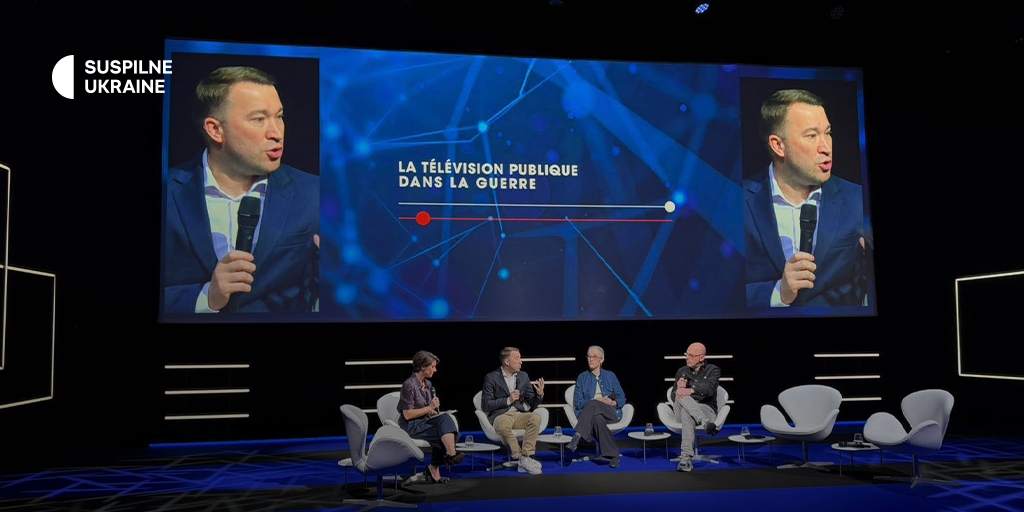
Mykola Chernotytskyi, Head of the Board of Suspilne Ukraine, and Delphine Ernotte Cunci, President of the European Broadcasting Union and CEO of France Télévisions, discussed the role of public broadcasters during wartime at the French broadcaster’s panel “War, interference, threats: media as actors in Europe’s defense.” The event brought together journalists, experts, government representatives, and leaders of public broadcasters from across Europe.
During the discussion, findings from a Bona Fidé study for France Télévisions were presented:
- 87% of Europeans believe their countries are targets of information attacks.
- 77% are convinced that manipulation of content and information from abroad can undermine democracies.
In this context, Mykola Chernotytskyi stressed that independent public broadcasters play a crucial role during crises and are an integral part of democracy. Flexibility and the ability to adapt quickly are essential for media operating in wartime:
“We must be flexible and adapt to everything happening around us. Russians have repeatedly tried to destroy our radio and TV towers, to hack our networks. Some of our offices are now simply destroyed, but we continue working — this is our responsibility. We must constantly think about our audience.”
The Head of the Board of Suspilne Ukraine also emphasized that editorial independence remains a core principle:
“Our role as a public broadcaster is to provide reliable information. We understand the restrictions on covering certain topics during wartime and comply with them, finding a balance between sensitive issues and information that is important for society. Decisions on what to publish are made by journalists, not by anyone outside.”
The war has radically changed media consumption patterns and increased the importance of hyperlocal journalism:
“At the beginning of the war, media consumption changed completely. Television is no longer in first place — 83% of Ukrainians consume media via Telegram and other social networks. In addition, people trust journalists working on the ground much more, so the role of local journalism has grown significantly. We have preserved our regional teams and now clearly see their importance,” Mykola Chernotytskyi noted.
Delphine Ernotte Cunci highlighted the importance of independent public broadcasting:
“A broadcaster that the public fully trusts is essential. Without a channel that operates across platforms — broadcast and social media — without a trusted channel, the army cannot communicate with the population, and this communication is absolutely key in wartime. So there are two things: independence — as Mykola said — and trust. And a third, more pragmatic point: the need to protect infrastructure and have backup solutions to ensure operations during war.”
The EBU President also pointed to the difficult balance journalists must maintain daily during war:
“The line that must be redefined every day in every story — between independence and loyalty to one’s country — is extremely complex, and it is upheld by journalists who work freely. Preserving journalists’ freedom — even if it involves debate and mistakes that are later corrected — is one of the most important elements both for a healthy democracy and for democracy during wartime,” said Delphine Ernotte Cunci.
Suspilne Ukraine is an independent media company with a strong presence across all platforms: the TV channels Pershyi, Suspilne Kultura, Suspilne Sport, and a national network of local channels; the radio stations Ukrainske Radio, Radio Promin, Radio Kultura, Radiotochka. Find only verified news on suspilne.media, as well as on our national and local digital platforms. We broadcast in minority languages, represent Ukraine at the Eurovision Song Contest, develop the children’s platform Brobaks, and train media professionals through the Public Media Academy. Our Suspilne Mediateka platform offers unique video and audio archives dating from the 1920s to today. Defending freedom in Ukraine.