

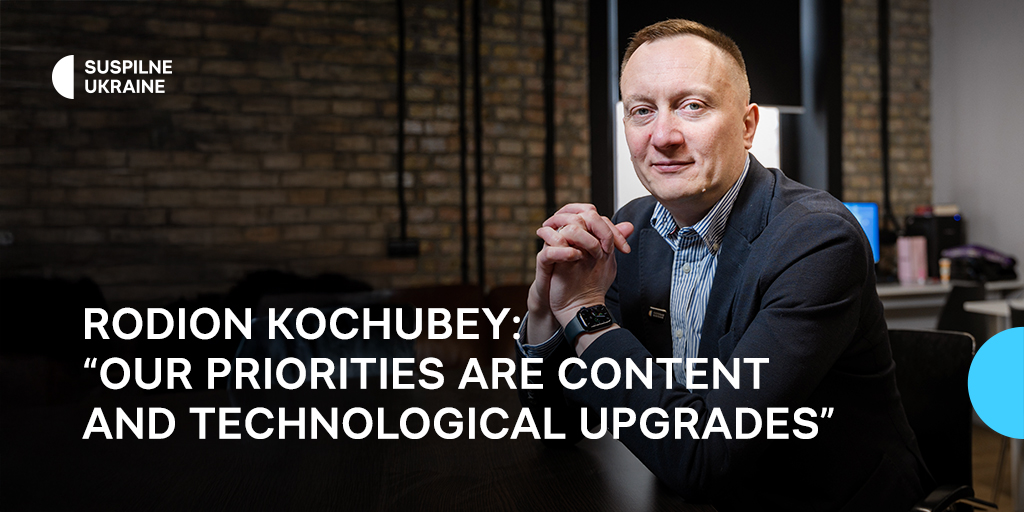
In wartime conditions, Suspilne Ukraine has developed processes that enable it to ensure continuous production and continue its development. It has been a journey from responding to crises to systematic strengthening. Rodion Kochubey, a Member of the Managing Board of Suspilne Ukraine, responsible for operational activities, talks about key decisions and priorities, the role of partners, and the implementation of AI in an interview.
— How have Suspilne Ukraine’s operational challenges changed since the start of the full-scale war?
— Of course, they have changed dramatically. February 2022 was a completely new experience — even with plans or scenarios in place, reality always looks different. We had to adapt as we went along. Over time, as we learned to work in conditions of constant turbulence and uncertainty, certain protocols and algorithms for responding to different types of threats emerged. Of course, even now we cannot predict what will happen with 100% certainty, but we already have a clear understanding of where, how, and what can affect our work, and we have the appropriate backup mechanisms in place. This gives us confidence that broadcasting will not be interrupted. The centralization of resources has also proven to be effective: we respond much faster and can quickly direct funding to solve specific problems in the regions.
— How have your challenges as an operations manager changed?
— The challenges of peacetime and the challenges of war are completely different circumstances. The scope of my tasks has changed accordingly. In particular, project and grant activities have been added, which have grown significantly and become critically important for strengthening our resilience.
— How would you assess the resilience of Suspilne Ukraine today?
— During the full-cale war, we have repeatedly proven that we are a resilient organization. We have gone through completely different, sometimes unpredictable challenges — from minor to very large-scale — and not only have we survived, but we have continued to develop. We did not stop, we did not regress, we did not degrade, but on the contrary — we made a significant leap forward. This is an indicator of our organizational resilience and ability to adapt.
Our strongest resource is our systematic approach and the ability of all departments to work towards a common goal.
As for our weakest points, they can always emerge in any crisis, and it is easy to say in hindsight that something could have been done better. However, it is important to look at the result: today we are much stronger than we were in 2021. We have grown in all areas — in some more, in some less. But overall, today Suspilne Ukraine is a fundamentally different company, capable of overcoming challenges and moving forward.
— What is Suspilne Ukraine focusing on right now?
— Our main business is content production. All of the operational processes I am involved in are aimed at ensuring its effective production and achieving the best results on all of our platforms. From a content production perspective, the key focus during the war is on high-quality news production. We have significantly strengthened our position in this area: the level of trust, reach, recognition, and views has increased on all platforms and distribution channels.
At the same time, we continue to develop cultural, sports, educational content, and products for children. Working with young audiences — from children to teenagers — is what we are particularly focused on right now. This year, in particular, we launched the first children’s app “Brobaks”, and this area will definitely continue to develop.
— Over the past few years, Suspilne Ukraine has significantly updated its technical infrastructure. What technologies or approaches do you think will be critical in the coming years?
— All equipment can be divided into three segments:
- For stationary production: studios that require specific specialization of people, equipment, and decorations.
- For mobile production: location shoots, events.
- Office equipment and software for daily work.
We invest primarily in areas that are key to our core business. Today, this is information broadcasting, so we first upgraded the equipment of regional and central newsrooms — for both stationary and mobile production. At the same time, we are upgrading other areas according to the same principle. However, technology is changing rapidly, so a one-time upgrade of equipment cannot meet our needs for long.
Given the importance of technological development, we have also institutionalized this area: the company now has a separate board member responsible for production and technologies, Dmytro Khilchenko. Accordingly, most of these functions are now his responsibility.
— Speaking of innovation, are you implementing AI in Suspilne Ukraine is work?
— Yes, the entire media industry is on the verge of tremendous changes due to the rapid development of artificial intelligence, and Suspilne is already moving in this direction. First of all, we have streamlined the rules and adopted our own principles for using AI. We are still at the initial stage of implementing AI tools, but we are already using them as aids for automating routine tasks in the news so that journalists and editors can focus more on content. We want to extend AI to all teams for transcription and sound work, assistance in gathering information, and eventually for creating drafts based on digital data templates. In the first half of next year, we plan to create a separate department that will systematically implement AI throughout the company in all areas of its activity.
— Support from partners and donors is very important for Suspilne Ukraine. Where is it most noticeable now?
— At the beginning of the full-scale war, support was mainly emergency support — donors helped to quickly meet the most critical needs. We reallocated the remains of old grants to urgent expenses, as the situation required quick decisions. Institutional agreements were formed during the first year, and we concluded new agreements that provide for long-term support.
Thanks to donor support, we have significantly strengthened our technical base. Our main donors remain the European Union, Japan (JICA), and Sweden (SIDA). We also have agreements with other organizations, such as DW Akademie and BBC MA, but they are mostly tied to the programs of the main donors.
As for funding priorities, they are fairly stable. These are primarily content production, technical equipment and infrastructure, training, experience sharing, and team training.
— Managing a team of over 3,600 people across the country is a big undertaking. What principles do you follow in your management work?
— I am very critical of the results of my own work, because there is always room for improvement. Personally, I try to follow these principles: don’t rush, because rushing always leads to wrong decisions, and don’t be afraid to cancel previous decisions if they are no longer relevant. In dynamic conditions, and especially during wartime, the latter is particularly important. You cannot be a hostage to something that no longer works.
— How do you see Suspilne Ukraine in a few years — in terms of production, structure, technology, and processes?
— I wouldn’t dare to make predictions, but we will definitely continue to live in conditions of numerous challenges. We have already been able to adapt to full-scale war as a company and as a media outlet — and continue to grow at the same time. It is clear that for a long time to come, regardless of when and under what conditions the war ends, we will remain under the influence of these circumstances, and the threat from Russia will remain existential. Similarly, internal challenges will not disappear — we have never been a peaceful country, and that is not always a bad thing. It is important that we already more or less understand how to work and develop in such conditions — both as a company and as an institution.
As for technological changes, it is even difficult to imagine what challenges we need to be prepared for. At the very least, we must actively study new technological solutions and involve as many employees as possible in learning how to use them correctly, especially those related to artificial intelligence. This challenge will be greater and more far-reaching than we can currently imagine.
Suspilne Ukraine is an independent media company with a strong presence across all platforms: the TV channels Pershyi, Suspilne Kultura, Suspilne Sport, and a national network of local channels; the radio stations Ukrainske Radio, Radio Promin, Radio Kultura, Radiotochka. Find only verified news on suspilne.media, as well as on our national and local digital platforms. We broadcast in minority languages, represent Ukraine at the Eurovision Song Contest, develop the children’s platform Brobaks, and train media professionals through the Public Media Academy. Our Suspilne Mediateka platform offers unique video and audio archives dating from the 1920s to today. Defending freedom in Ukraine.